Developing real estate is not an option, but rather an obligation for every project developer to contribute to environmental and social sustainability.
Depending on the calculation method, Germany’s building stock accounts for about 30 to 40 percent of the country’s total energy consumption. We can only achieve our climate goals if we make this building stock fit for the future again. That is our mission. In addition to the global sustainability goals, we have therefore defined our own targets—which we implement through eco-friendly construction, renovation, and climate-friendly operation of buildings and neighborhoods. When it comes to existing buildings, this means:
- Postponing the CO₂ stranding point according to CRREM by at least ten years
- Reducing final energy consumption by at least 30 percent compared to the time of purchase
- Compliance with the EU Taxonomy
- BREEAM certification for existing buildings of at least “Very Good”
But the mission doesn’t stop at energy-efficient retrofitting: In addition to high energy consumption and a poorcarbon footprint, older office buildings also tend to fare poorly in terms of comfort. This affects the leasing situation and, consequently, cash flow. Spending time in an existing building should be enjoyable again—that’s why the well-being of the occupants is just as important to us as our contribution to climate protection.


Don't be reckless—be brave!
So how? “Just go for it—be bold,” says Frederike Krinn, head of Landmarken’s Rhein-Main branch, which focuses intensively on sustainable redevelopment of existing properties. Commercial properties in particular offer a wealth of opportunities for “placemaking”—that is, the creation and repositioning of spaces with a focus on sustainability: “It would be negligent of us not to address this!”
A good example is one of our portfolio development projects in Bonn: Over nearly two years, we drove forward the energy transformation concept for the Lindeblock and worked to convince potential tenants that it offers genuine added value, even in terms of the cost-benefit ratio. Ultimately, it was precisely these aspects that tipped the scales in favor of the City of Bonn leasing the space. This shows us that we’re on the right track with our “Manage-to-ESG” concept for portfolio transformation!
The Lindeblock in Bonn, built in 1993 and featuring approximately 8,200 m² of rental space, is currently undergoing design upgrades and energy-efficiency renovations. In addition to apartments, the mixed-use complex houses a library, a bike shop, and a post office. However, office space dominates the complex, and a significant portion of it had been vacant—until the City of Bonn leased it (approximately 5,000 square meters) for at least ten years and took over the property in April 2025. The city’s decision to lease the space was driven by the building’s energy-efficiency measures, such as the installation of a photovoltaic system, the incorporation of heat pumps for energy supply, and the implementation of a smart metering and monitoring system. The inner courtyard is also being upgraded and landscaped to enhance the quality of the outdoor space.


“Transforming existing structures is urban renewal. It’s more than just putting on a band-aid; it can heal the entire neighborhood.”
Frederike Krinn, Branch Manager for the Rhein-Main Region, Landmarken
Energy Design Using Artificial Intelligence
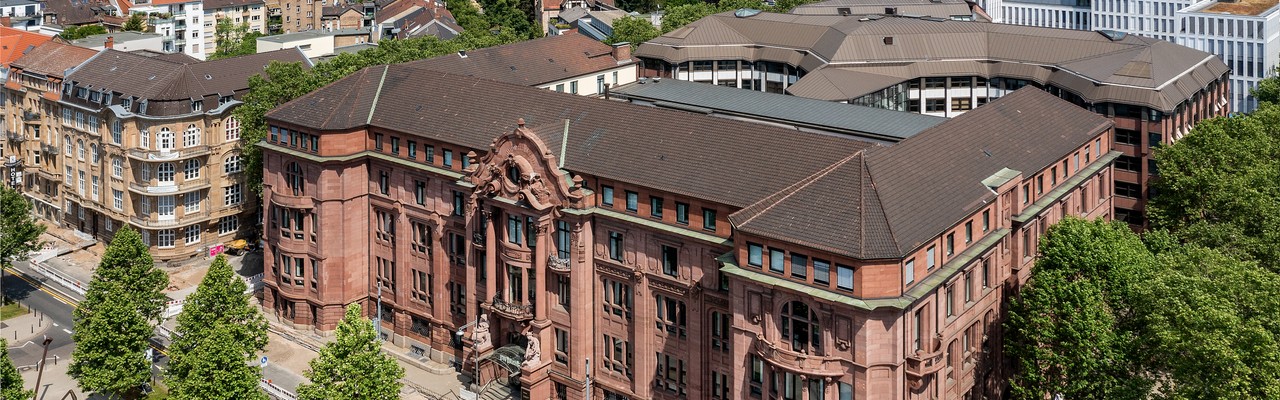
AUGUSTA 33 is located in Mannheim, about 170 km up the Rhine. This approximately 28,000 m² historic, protected complex was revitalized by our sister company, The Urban Village, with new interior design and color schemes, and we upgraded its energy efficiency: Through the minimally invasive installation of sensors, we were able to collect all key data on the building’s structural behavior and existing building systems, and use artificial intelligence to create a customized energy design.
“We meet the needs of both existing and new tenants under one roof, so that everyone feels truly at home,” says Frederike Krinn. “The companies we speak with want to bring their employees back to the office—not through quotas and regulations, but through culture and amenities.”
That’s why we’ll continue to expand our efforts focused on the existing building stock. “We’re looking for properties that need a fresh vision: older, only partially leased buildings that can be made truly cool again—while they’re still in operation—through carefully measured, structured measures.”